
From ACT Apricot to Modern Tech: My History with Computers
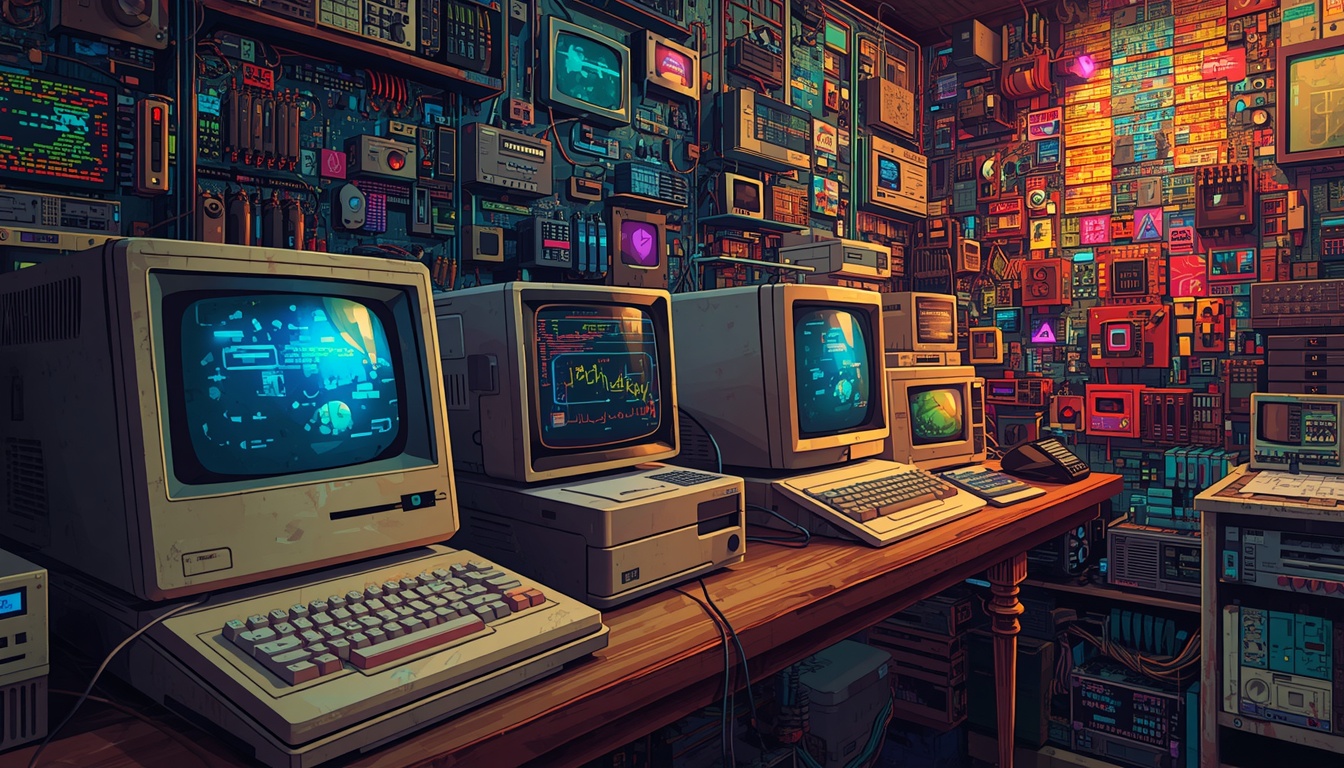
Long before the era of cloud-connected story engines, seamless API integrations, and multi-monitor setups, computing was an entirely hands-on, mechanical, and beautifully strict affair. If you grew up wrestling with the early waves of British personal computing in the 1980s, you know that technology didn't cater to passive users. It demanded that you understand its internal logic. Looking back across the decades—from tiny 8-bit RAM blocks to the sophisticated digital writing stack running in my studio today—tracing that hardware evolution is like reading the source code of my own creative workflow. Here is a look back at the silicon milestones that shaped my journey as a writer, technician, and lifelong lover of organized systems.
C. NOSTALGIA
From ACT Apricot to Modern Tech: My History with Computers
Long before the era of cloud-connected story engines, seamless API integrations, and multi-monitor setups, computing was an entirely hands-on, mechanical, and beautifully strict affair.
If you grew up wrestling with the early waves of British personal computing in the 1980s, you know that technology didn't cater to passive users. It demanded that you understand its internal logic. Looking back across the decades—from tiny 8-bit RAM blocks to the sophisticated digital writing stack running in my studio today—tracing that hardware evolution is like reading the source code of my own creative workflow.
Here is a look back at the silicon milestones that shaped my journey as a writer, technician, and lifelong lover of organized systems.
1. The 1 MHz Spark: The Acorn Atom (1980)
Every obsession has an origin point. For me, the journey began in 1980 with the Acorn Atom.
Manufactured in Cambridge, England, the Atom was a masterclass in minimalism. Running on a MOS 6502 processor clocked at 1 MHz, the base machine housed a modest 2 KB of RAM. If you wanted to do anything—whether it was running a basic loop, storing a text file, or creating primitive screen graphics—you had to write efficient, ruthless code.
The Lesson: The Atom taught me constraint discipline. When you only have 512 bytes of user memory to play with, there is zero room for bloat. That exact mindset governs my editing process today: strip away the passive descriptions, clear out the "memory leaks" in a scene, and keep the underlying logic lean.
2. Professional Ambition: The ACT Apricot Series (Mid-1980s)
Moving out of the hobbyist era brought the arrival of Applied Computer Techniques and their iconic ACT Apricot range.
Where the Acorn felt like an experimental workbench, the ACT Apricot felt like serious, high-grade engineering. With its crisp monochrome monitor, 3.5-inch Sony microfloppy drives (a massive leap from bulky 5.25-inch disks or cassette tapes!), and integrated LCD "Microscreen" right on the keyboard, it was a glimpse into the future of business computing.
The Lesson: The Apricot introduced me to structural workflows. Running MS-DOS (and Apricot’s own custom menu interfaces) showed me how powerful a dedicated system could be for organizing data, tracking records, and managing long-form documents. It bridged the gap between home-brew programming and professional productivity.
3. The Great PC Acceleration: DOS, Windows, and the Digital Workspace
As the late 80s transitioned into the 90s, the computing landscape shifted from proprietary British hardware to the standardized PC architecture.
[ THE HARDWARE EVOLUTION PIPELINE ]
+-------------------------------------------------+
| ERA 1: THE 8-BIT TAPE AGE (Acorn Atom) |
| - 1 MHz, cassette storage, raw machine code. |
+-------------------------------------------------+
|
v
+-------------------------------------------------+
| ERA 2: THE BUSINESS FLOPPY ERA (ACT Apricot) |
| - MS-DOS, 3.5" disks, specialized hardware. |
+-------------------------------------------------+
|
v
+-------------------------------------------------+
| ERA 3: THE HIGH-SPEED CONNECTED STUDIO (Present)|
| - OpenRouter, Novelcrafter, cloud databases. |
+-------------------------------------------------+
The days of waiting ten minutes for a tape to load or managing disk swapping gave way to gigabytes of hard drive space, word processors with built-in spellcheckers, and eventually the vast connected library of the internet.
4. The Modern Studio Stack: AI Sounding Boards and Story Engines
Today, my desk in Mount Vernon (and soon New Hampshire) looks drastically different from that 1980 setup, but the fundamental principle remains the same: using technology to eliminate friction and enforce consistency.
My modern writing stack is built like a digital command center:
Novelcrafter: Serving as my central mainframe, where the Series Bibles, world-building tech trees, and 40,000-word episodic structures are hard-coded.
OpenRouter Integration: Using advanced AI models as a technical "rubber duck" to stress-test plot logic, debug scene blocks, and verify period consistency.
Google Sheets: Managing character directories, release schedules, and logistics ledgers down to the last word-count density target.
The Unbroken Thread
Looking back from a modern, multi-gigahertz workspace to a 1 MHz cassette-driven keyboard, it’s easy to feel like we’re living in a completely different world. But the core philosophy hasn't changed.
Whether you are fitting a program into 512 bytes on an Acorn Atom, managing data spreadsheets on an ACT Apricot, or organizing a 20-book series inside a modern story engine, technology is simply a tool to help us bring order to chaos. It’s about building a system that works, respecting the rules of the code, and letting your imagination run at full speed.