
How to Manage 20+ Books: Staying Organized as a Prolific Author
When you cross the threshold into becoming a prolific author with a deep catalog, writing ceases to be just an artistic pursuit. It becomes an engineering and logistics challenge. Managing a vast library of interconnected books, distinct genres, and serialized universes means you are no longer just a narrator—you are a structural technician overseeing a massive creative architecture. If you leave your universe data to memory alone, your creative systems will inevitably experience a narrative system crash. Maintaining continuity, tracking individual character versions, and pushing projects forward requires a highly systematic organization workflow. Here is the master blueprint for managing a deep-catalog writing workshop without losing your mind.
B. WRITING TIPS
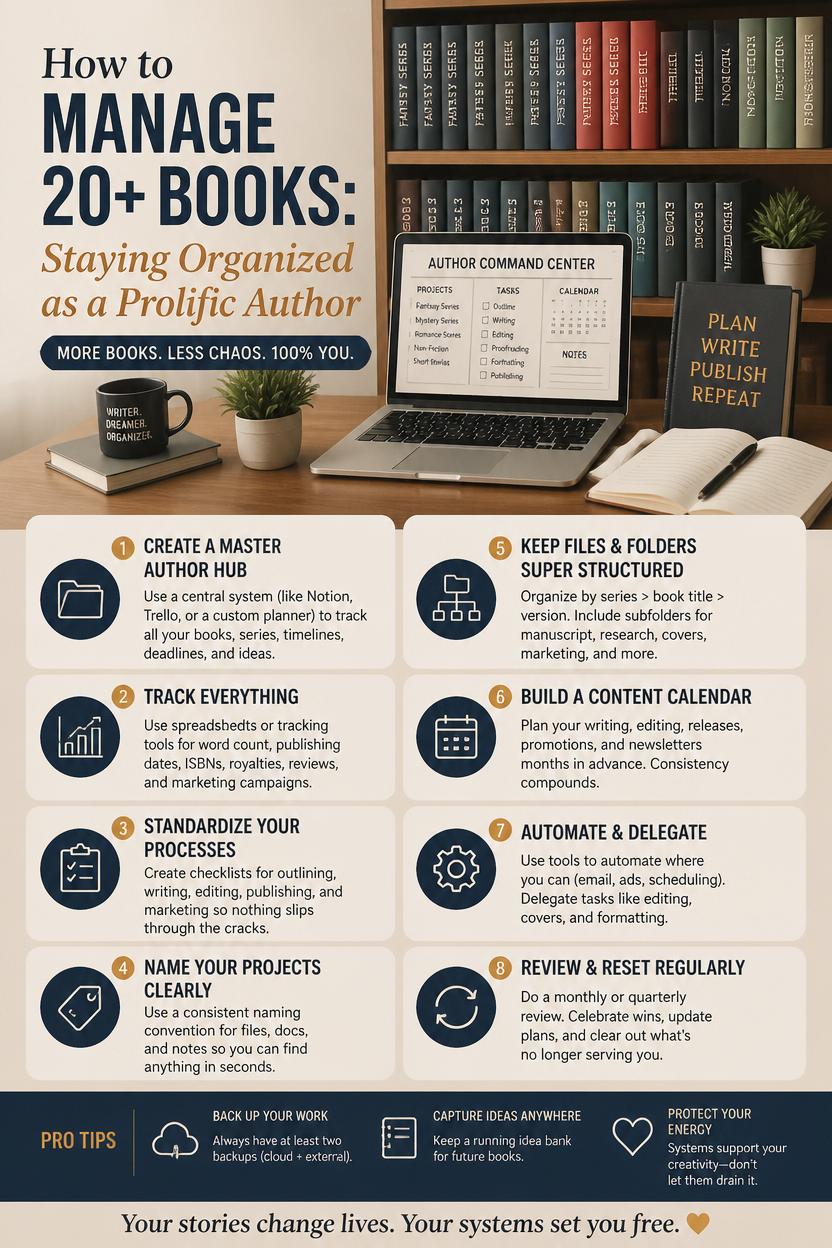

How to Manage 20+ Books: Staying Organized as a Prolific Author
When you cross the threshold into becoming a prolific author with a deep catalog, writing ceases to be just an artistic pursuit. It becomes an engineering and logistics challenge. Managing a vast library of interconnected books, distinct genres, and serialized universes means you are no longer just a narrator—you are a structural technician overseeing a massive creative architecture.
If you leave your universe data to memory alone, your creative systems will inevitably experience a narrative system crash. Maintaining continuity, tracking individual character versions, and pushing projects forward requires a highly systematic organization workflow.
Here is the master blueprint for managing a deep-catalog writing workshop without losing your mind.
1. Hard-Code the Universe: The Series Bible Baseline
You cannot manage dozens of books in a vacuum. Before managing the micro-level of a single chapter, you must secure the macro-level of your lore.
Establish a Master Repository: Maintain a centralized, digital database—using comprehensive story engines like Novelcrafter—to house the immutable laws of your worlds.
The Hardware Ledger: Catalog every magical artifact, technological framework, or historical relic with rigid operational rules. If a relic runs on a strict kinetic circuit or demands emotional reciprocity, document those variables so they compile identically across multiple books.
The Linguistic & Textual Guardrails: Hard-code your world's foundational scripts, cultural phonetics, and ancient folklore—such as continental prophecies or practical maxims—directly into your archive. When a villain or a hero quotes an old scroll in Book 20, the coordinate system must align flawlessly with Book 1.
2. Track Character Life Cycles and Evolutionary Paths
Managing an expansive character directory across 20+ books means tracking active versions, visual profiles, and shifting allegiances over time.
Implement Visual Punctuations: Give ensemble members distinctive visual signatures to keep them from bleeding together in crowded timelines. Tracking a character's aesthetic evolution—like maintaining a specific, defiant wardrobe color—creates immediate visual shorthand across long arcs.
Log Emotional & Relationship Dynamics: In long-form formats, characters require quiet spaces to breathe. Document the slow-burn pacing of platonic and romantic subplots within your bible so character trust builds organically across a multi-book sequence rather than a forced plot march.
Archive Completed Assets: When a specific story arc finishes or a standalone project concludes, file those characters away neatly in your database. Knowing when to close a project file allows you to clear your mental processing buffer and transition efficiently to the next series.
3. Build the Narrative Topography (Cartography First)
A map is the ultimate structural guardrail against continuity errors. For an author balancing multiple realms, keeping geography locked down is mandatory.
[ THE CENTRAL CONTINUITY PIPELINE ]
+-------------------------------------------------+
| 1. MASTER MAP: Defines terrain, borders, and |
| hard physical travel distances. |
+-------------------------------------------------+
|
v
+-------------------------------------------------+
| 2. TECH TREE: Houses lore, social etiquette, |
| and environmental variables. |
+-------------------------------------------------+
|
v
+-------------------------------------------------+
| 3. EPISODIC BEATS: Tracks individual movements |
| against the macro structural arc. |
+-------------------------------------------------+
Enforce Logistical Logic: A detailed map forces you to respect the physical constraints of your environment. It prevents the trap of "narrative teleportation," ensuring that characters face the realistic, grueling weight of travel, distance, and terrain.
Maintain Regional Consistency: Whether your setting is a soot-stained historical port or a prophetic desert plain, the geography must remain anchored. If an early chapter mentions a specific coastal reef or a mountain pass, that asset must sit in the exact same coordinates five books later.
4. Break Content Down into Modular Movements
Faced with the daunting task of writing and maintaining a massive catalog, stop looking at the peak of the mountain. Instead, treat your writing schedule like a series of predictable, modular sprints.
Utilize Word-Count Density Targets: Standardize your production length. If you anchor your installments around heavy, immersive formats—such as 40,000-word episodes—you can systematically break the bulk down into predictable movements.
Run a Diagnostic Scan on Stalled Scenes: When a scene breaks, stop trying to write through the block with raw emotion. Treat it as a logic error. Strip the scene down to its bare bones (evaluate raw dialogue voltage), clear out over-description, and use technical "rubber ducking" strategies to debug the character logic before compiling the final prose.
Balance the "Odds & Sods": Do not let your creative engine burn out on multi-book continuity alone. Use standalone short stories and vignettes as research-and-development labs. They clear your creative buffer, let you test new environmental variables safely, and act as highly accessible entry points for new readers.
5. Run Your Production Workshop with Digital Efficiency
A prolific output demands organized infrastructure. Treat your writing studio like an efficient workspace where every tool has a clear, programmatic purpose.
Automate Project Management: Use centralized spreadsheets—like Google Sheets—to track your overarching word counts, production schedules, release goals, and logistical checklists.
Employ an AI Sounding Board: Never look at artificial intelligence tools as something to drive the story or replace your voice. Instead, access advanced models via tools like OpenRouter to act as a sophisticated, technical sounding board. Use them to critique plot logic, stress-test your world-building constraints, and verify that your villains' motivations make flawless structural sense.
By establishing strict world-building constraints, organizing your production into clear milestones, and treating your deep catalog as a beautifully calibrated piece of clockwork, your stories will remain completely immersive—and your writing workshop will remain beautifully organized from book one to book twenty and beyond.
For those managing extensive projects or deep libraries, what is your primary anchor for keeping details straight? Do you find that a highly visual tool like a map or a text-heavy tech tree keeps your continuity intact?