
"Odds & Sods" Philosophy: Why Standalone Stories are Vital
In the world of series writing—where I spend much of my time navigating the 40,000-word episodes of Brassbridge or the paranormal corridors of Wormwood House—it is easy to become obsessed with the "Big Picture". We writers often find ourselves tethered to long-term character arcs and multi-book continuity. But there is a specific, often overlooked joy in the "Odds & Sods." In British parlance, "odds and sods" refers to the miscellaneous bits and pieces, the leftovers, or the small items that don’t quite fit into a larger category. In a writer's portfolio, these are the standalone stories—the vignettes, the short experiments, and the "what if" scenarios that exist outside of a flagship series. Here is why this philosophy is vital for any creative, especially those of us who take a "Technician's Approach" to our craft.
D. DEEP DIVES
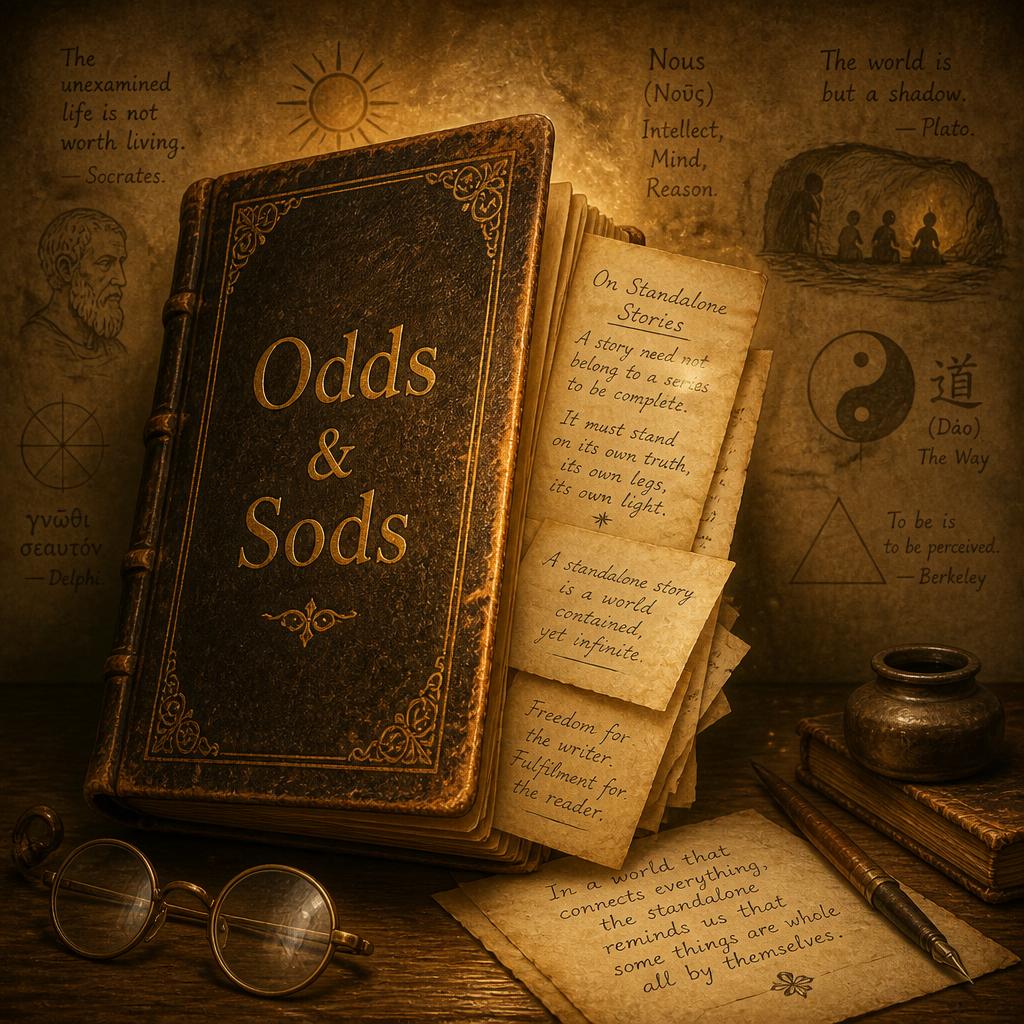
"Odds & Sods" Philosophy: Why Standalone Stories are Vital
In the world of series writing—where I spend much of my time navigating the 40,000-word episodes of Brassbridge or the paranormal corridors of Wormwood House—it is easy to become obsessed with the "Big Picture". We writers often find ourselves tethered to long-term character arcs and multi-book continuity.
But there is a specific, often overlooked joy in the "Odds & Sods."
In British parlance, "odds and sods" refers to the miscellaneous bits and pieces, the leftovers, or the small items that don’t quite fit into a larger category. In a writer's portfolio, these are the standalone stories—the vignettes, the short experiments, and the "what if" scenarios that exist outside of a flagship series.
Here is why this philosophy is vital for any creative, especially those of us who take a "Technician's Approach" to our craft.
1. The R&D Lab of the Narrative Technician
For a writer who builds universes before the first chapter, standalones are your Research and Development department.
Testing Systems: If I have a new idea for a magical mechanic or a specific Edwardian-era procedural detail, I might not want to risk "breaking" the established logic of a 20-episode arc.
Modular Prototyping: A standalone allows me to test that "circuit" in a controlled environment. If it works, it might eventually find its way into a major series; if it doesn't, the "system crash" is contained to a single story.
2. Clearing the Creative "Buffer"
Sometimes an idea hits you that is perfectly formed but inherently limited. It’s like a single vintage postcard or a specific stamp in a scrapbook—beautiful on its own, but not meant to be a whole album.
Narrative Palate Cleansers: After deep-diving into the complex paranormal romances or the "Strong-Brain" writing of a long series, a standalone provides a breather.
Efficiency: Writing a standalone prevents these ideas from clogging up your mental processing. You get them out, you polish them, and you move back to the main series with a clear head.
3. The "Taster Menu" for New Readers
From a reader's perspective, jumping into a multi-book series can feel like a massive commitment.
Standalones act like the cockle stalls on the old Poole Quay—a quick, flavorful bite that gives you a sense of the place without requiring a full sit-down meal.
Lowering the Barrier: A 5,000-word standalone allows a reader to experience my voice, my world-building style, and my "JC Dorset" brand without needing a Series Bible to keep up.
Showcasing Versatility: It’s a chance to show that you can do more than just one thing. Maybe it’s a quick dip into steampunk or a brief, haunting paranormal encounter that doesn't involve seven witches.
4. Preserving the "Scrapbook" Mentality
I’ve always been drawn to the aesthetic of the collage—the mixture of vintage advertisements, handwritten notes, and postcards. A writing career should feel the same way.
Texture and Variety: A portfolio that is only long-form series can feel a bit industrial. The standalones add "texture." They are the personal notes in the margins of your professional work.
Capturing Moments: Some stories are about a specific mood or a memory—perhaps something sparked by the salt air of Dorset or a bit of Scouting history—that doesn't need a 40,000-word trajectory to be meaningful.
The Final Word
The "Odds & Sods" aren't just leftovers; they are the essential components that keep a writing life vibrant. They provide the freedom to fail, the space to experiment, and the joy of a story told for its own sake.
Every technician needs a "junk drawer" of parts that don't fit anywhere else—because you never know when one of those odd pieces might be exactly what you need to fix a broken scene in the next big book.