The 40,000-Word Episode: My Process for Drafting Series Installments
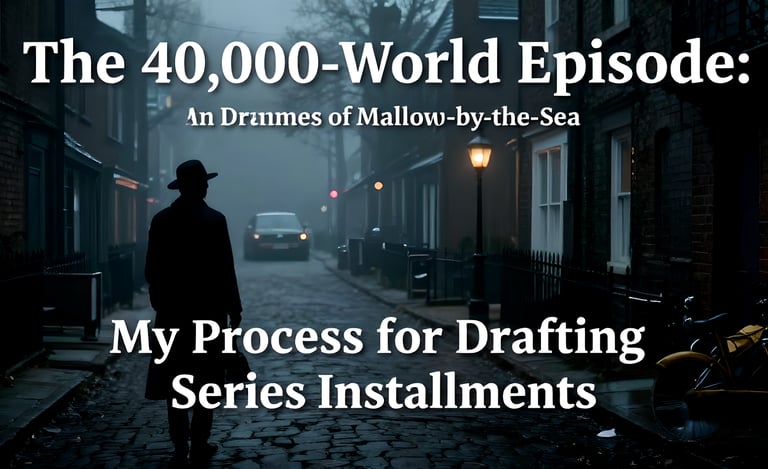
When people hear "episode," they usually think of a quick 20-minute TV script or a 5,000-word short story. But for me, the story demands more room to breathe. In my current work—particularly within the foggy, gaslit streets of Mallow-by-the-Sea—an episode clocks in at a meaty 40,000 words. It’s not quite a standalone novel, but it’s far more than a vignette. It’s a "mini-novel" that allows for the investigative depth of a Holmesian mystery and the slow-burn tension of a paranormal romance. Here is the "JC Dorset" method for drafting these heavy-duty installments.
B. WRITING TIPS
The 40,000-Word Episode: My Process for Drafting Series Installments
When people hear "episode," they usually think of a quick 20-minute TV script or a 5,000-word short story. But for me, the story demands more room to breathe. In my current work—particularly within the foggy, gaslit streets of Mallow-by-the-Sea—an episode clocks in at a meaty 40,000 words.
It’s not quite a standalone novel, but it’s far more than a vignette. It’s a "mini-novel" that allows for the investigative depth of a Holmesian mystery and the slow-burn tension of a paranormal romance.
Here is the "JC Dorset" method for drafting these heavy-duty installments.
1. The Architectural Phase: The Series Bible
You cannot write 40,000 words in a vacuum. Before a single word is typed, I consult the Series Bible.
Because I’m managing an ensemble—like my seven witches at Wormwood House—I need to know exactly who is where and what their current power levels are. For an Edwardian setting, continuity is king. If I mention a specific brand of matches or a particular steam carriage in Chapter 2, it has to be there in Chapter 20. I use this phase to map out the "Episode Arc" against the "Series Arc," ensuring the immediate mystery is solved while the larger paranormal threat looms closer.
2. Breaking the "Big Black" into Beats
Writing 40,000 words is like climbing a mountain; if you look at the peak, you’ll freeze. Instead, I look at my boots.
I break the episode into four 10,000-word movements:
The Hook & The Haunting: Establishing the Edwardian atmosphere and the "unexplained" event.
The Investigation: Utilizing the methodical, deductive approach of the classics (think Poirot’s "little grey cells") to gather clues.
The Complication: Where the paranormal elements and the romantic subplots collide, raising the stakes.
The Resolution: A high-octane climax followed by a "coda" that sets the stage for the next installment.
3. The Digital Workshop: Novelcrafter & AI
I’m a firm believer in using the best tools available. I treat my writing environment like a digital "bedroom coding" setup from the 80s—efficient and customized.
I use Novelcrafter to house my lore and "Beats." When I hit a wall on a specific Edwardian detail or need to brainstorm a paranormal twist, I pull in AI models via OpenRouter. I don't let the AI drive; I use it as a sophisticated sounding board to test plot logic or to help visualize a complex scene before I commit the prose to the page.
4. Drafting for "Atmospheric Density"
In a shorter piece, you often have to sacrifice atmosphere for pace. At 40,000 words, I don’t have to. I can spend a page describing the way the sea mist rolls off the Dorset coast or the specific etiquette of an Edwardian tea service.
This length allows for Character Breathability. My characters can have quiet moments—a shared look over a dusty tome or a tense conversation during a carriage ride—that build the romance naturally rather than forcing it.
Why Go This Big?
At the end of the day, I write the stories I want to read. I want to get lost in a world for a few hours, not just a few minutes. The 40,000-word episode is my way of giving the reader a complete, immersive experience that feels earned.
It’s a marathon, not a sprint, but the view from the finish line—when the mystery is solved and the magic is real—is always worth the effort.