
The Art of the Map: Why I Include Detailed Maps in Every Book
There is a distinct, visceral magic that happens before you even read the first sentence of a fantasy novel. You open the cover, turn the page, and there it is: a sprawling, hand-drawn map. Your eyes trace the coastlines, wander through dense forests, and linger on the names of ancient cities. For me, a map isn't just a decorative illustration or a marketing gimmick. It is a vital architectural tool. Following a technician’s approach to creative writing, I ensure that a detailed map accompanies every single project—whether it's the sweeping continent of my epic fantasy work, The Southern Lands, or the tight, fog-enshrouded coastal geography of a paranormal mystery. Here is why cartography is the ultimate foundation of my world-building process.
A. THE "ADD-ONS"
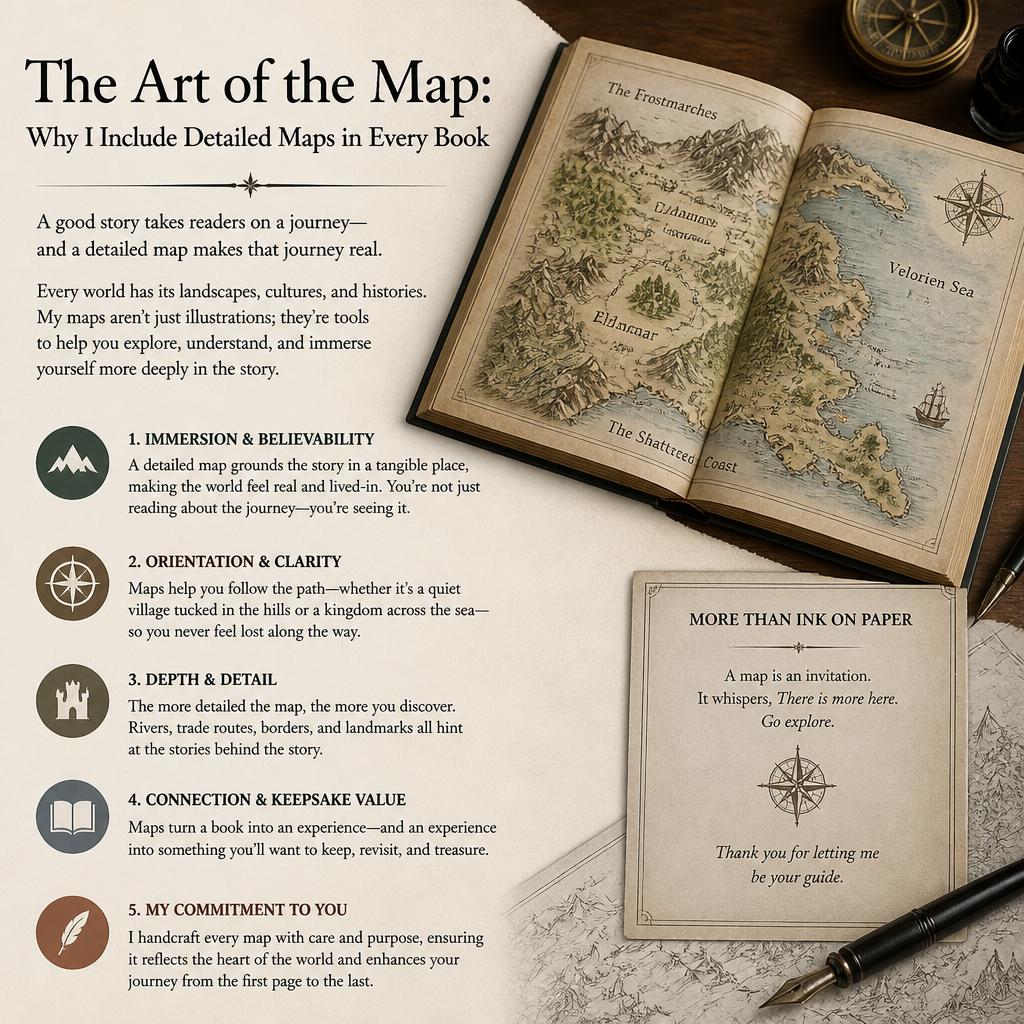
The Art of the Map: Why I Include Detailed Maps in Every Book
There is a distinct, visceral magic that happens before you even read the first sentence of a fantasy novel. You open the cover, turn the page, and there it is: a sprawling, hand-drawn map. Your eyes trace the coastlines, wander through dense forests, and linger on the names of ancient cities.
For me, a map isn't just a decorative illustration or a marketing gimmick. It is a vital architectural tool. Following a technician’s approach to creative writing, I ensure that a detailed map accompanies every single project—whether it's the sweeping continent of my epic fantasy work, The Southern Lands, or the tight, fog-enshrouded coastal geography of a paranormal mystery.
Here is why cartography is the ultimate foundation of my world-building process.
1. Hard-Coding the Narrative Topography
Before a single chapter is written, the map acts as my world's "source code." If I don't know the physical distance between two towns, I can't accurately calculate the logistical reality of the characters' journey.
Logistical Logic: If a protagonist needs to travel from a coastal port to an inland manor, the map forces me to respect the terrain. How long does a steam carriage take to traverse a muddy mountain pass? Is there a river crossing that could be flooded by a sudden storm?
The "Anti-Teleportation" Guardrail: Without a map, it is dangerously easy to fall into the trap of "narrative teleportation," where characters magically arrive at their destination exactly when the plot requires it. A map forces honesty. It ensures that the grueling weight of a journey is felt by the characters and, by extension, the reader.
2. The Map as a Narrative Engine
A well-constructed map doesn't just display geography; it hints at history, politics, and ancient conflicts. The placement of a mountain range or a narrow sea strait immediately tells you where trade routes will form—and where armies will clash.
The Cartographic Spark: Sometimes, drawing the map actually creates the story. You sketch a jagged peninsula or a cluster of isolated islands and think: Who lives there? Why are they cut off from the mainland? What happens if an ancient power awakens beneath those waters?
In The Southern Lands, every mountain peak and river bend is explicitly tied to the ancient lore and lines of the Prophecy of Xannu. The geography itself is an active participant in the destiny of the characters.
3. Creating Visual Consistency for the Reader
As a writer, I operate under a strict philosophy when it comes to character art and promotional imagery: a preference for textures, silhouettes, and landscapes over explicit faces. I want to leave room for the reader's imagination to paint the cast.
Maps fit perfectly into this manifesto.
[ THE CARTOGRAPHIC VISUAL PIPELINE ]
+---------------------------------------------------+
| STEP 1: The Rough Outline (Hand-drawn sketches) |
+---------------------------------------------------+
|
v
+---------------------------------------------------+
| STEP 2: The Technical Audit (Distance & Logic) |
+---------------------------------------------------+
|
v
+---------------------------------------------------+
| STEP 3: The Finished Asset (Etched ink & lore) |
+---------------------------------------------------+
A map provides a dense, rich visual anchor without dictating exactly how a character looks or emotes. It offers a macro-view of the universe, allowing the reader to orient themselves within the world's atmosphere while keeping their imagination entirely free to inhabit the characters' personal spaces during a 40,000-word episode.
4. The Continuity Ledger
Because I write across expansive series and distinct realms, my maps serve as a physical contract with my readers. If a reader flips back to the map in Book One, and then checks the map in Book Five, the mountains cannot have moved.
I use tools like Novelcrafter to manage my world-building tech tree, and the map is the primary visual interface for that database. It ensures that if I mention a specific reef off the coast of a port town in an early chapter, that reef is exactly where it belongs when a ship encounters it three books later.
The Final Line
To build a universe before you write the first chapter requires a blueprint. The map is that blueprint. It changes a fictional environment from a hazy, ethereal concept into a real, solid place with borders, dangers, and horizons.
When you give a reader a map, you aren't just inviting them to read a book. You are handing them a compass and inviting them to explore a living world.
When you open a new fantasy or adventure book, do you immediately flip to the map, or do you prefer to let the geography unfold entirely through the text? Let me know your thoughts in the comments!